

Title:
Assistive Robotic System and Method for Enhancing Social Skills in User with Autism Spectrum Disorder
Author:
Dr. Anup Nandy, Mr. Sougatamoy Biswas, Dr. Asim Kumar Naskar, Mr. Sarthak Sahoo
Abstract:
The present invent
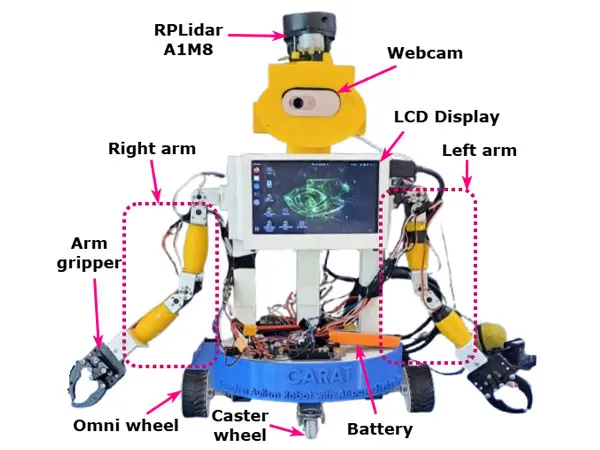
ion relates to an Artificial Intelligence enabled socially assistive robotic system specifically developed to support children with Autism Spectrum Disorder (ASD). Many autistic children require structured, repetitive, and visually guided intervention sessions to gradually develop social reciprocity, joint attention, gesture imitation, and coordinated motor responses. The proposed system addresses this need by providing a consistent, engaging, and autonomous therapeutic interaction platform. The assistive system, named Caregiver Autism Robot with AI based Technology (CARAT), integrates Artificial Intelligence algorithms with embedded computing platforms, on-board vision sensors, and coordinated motor control mechanisms. It enables natural real time human robot interaction, primarily by visual perception and physical gestures. The robot continuously observes the child's hand and body movements, interprets them through on-board processing, and responds with synchronized robotic arm actions to encourage bidirectional engagement. Unlike conventional assistive tools that depend mainly on speech based commands, the proposed system emphasizes gesture centric interaction, which is particularly beneficial for autistic children who may have limited or delayed speech development. The platform promotes imitation learning by demonstrating structured arm and body gestures such as hand waving, greeting motions, hands up, hands down, and guided object based interaction activities, thereby supporting motor coordination, behavioral adaptation, and gradual improvement in social responsiveness. The robotic system further incorporates an on-board visual display that presents adaptive learning content including symbolic cues, animated prompts, and reinforcement feedback aligned with therapeutic objectives to sustain attention and create predictable interaction routines that are comforting for children with ASD. The system performs expressive and safe physical actions within indoor environments such as therapy centres, special education classrooms, and homes. The integrated power efficient architecture performs all perception, decision making, and control locally on the robot to ensure privacy preserving operation and uninterrupted autonomous sessions. The present work contributes an integrated assistive framework combining gesture recognition, adaptive visual reinforcement, autonomous robotic response, and structured interaction methodology to support long term social skill development and independent therapeutic engagement for autistic children.