




NIT Rourkela Researchers Develop Reconfigurable Fractal Antenna for Next-Generation Space and Wireless Applications
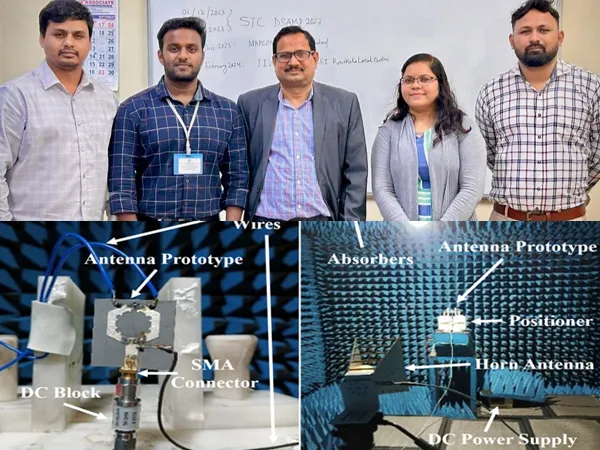
Researchers from the RF & Microwave Systems Group, Department of Electronics and Communication Engineering, National Institute of Technology Rourkela, have developed a compact, low-cost, and high-performance polarization reconfigurable Koch fractal antenna designed for space and advanced wireless communication applications. The innovative antenna offers wideband frequency coverage, high gain, and multiple polarization modes, making it suitable for satellite communication, radar systems, cognitive radio, and other high- speed wireless technologies.
The proposed antenna features a simple and compact design fabricated on a Rogers RT/Duroid substrate. By integrating just two PIN diodes, it can switch between linear polarization (LP), right-hand circular polarization (RHCP), and left-hand circular polarization (LHCP) without compromising radiation performance. Its uncomplicated geometry and simplified biasing network enable easy fabrication while ensuring reliable operation across a wide frequency range of 3 to 7.91 GHz.
Beyond satellite communication, the antenna has the potential to support a variety of emerging wireless applications, including cognitive radio and ISM band systems. The researchers also suggest that the design can be further integrated with advanced electromagnetic structures such as artificial magnetic conductors (AMC), electromagnetic band-gap (EBG) structures, metamaterials, and defected ground structures (DGS) to enhance antenna performance. The concept can also be extended to antenna arrays for multitasking radar detection and advanced satellite communication systems.
The research has been published in the prestigious International Journal of Microwave and Wireless Technologies. The study was carried out by Ms. Khushbu Patel and Prof. Santanu Kumar Behera from the Department of Electronics and Communication Engineering, NIT Rourkela.